


Introducing Adaptive PCR and Autonormalization
Individual optimization of PCR cycle numbers in real-time
The newly acquired iconPCR instrument from n6tec enables a completely new PCR approach: Adaptive PCR. It allows the individual optimization of the number of PCR cycles for each sample. The "icon" moniker is derived from the words individually controlled.
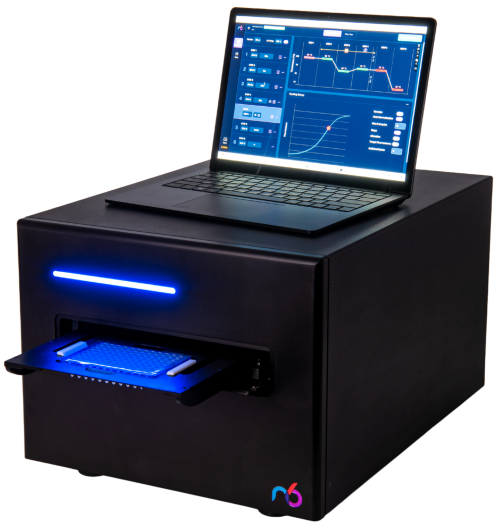
The iconPCR is a single-color real-time PCR instrument with a unique feature: The number of PCR cycles can be controlled independently and in real-time for each sample, based on the measured fluorescence. SyBR-Green dye fluorescence is used to monitor the production of double-stranded DNA product. Several algorithms are available to determine the optimal stopping point (PCR cycle) individually for each of the samples: E.g. target fluorescence, slope (determines the inflection of the amplification curve), xBaseline (target fluorescence will be a multiple of the baseline fluorescence). For more detailed information please see the n6tec website and this slide deck.

Real-time fluorescence data for a 96-sample DNA library preparation. The amplification stops after 2 to six PCR cycles when an intensity threshold of 20,000 is reached.
For our most common application, the amplification of sequencing libraries, the technology enables a rough autonormalization of the resulting library amounts. More importantly it prevents the underamplification and overamplification of PCR libraries, both of which are detrimental to the library prep process. Despite normalizing the input amounts into sequencing library preparations, samples frequently show considerable variation in sample quality and the conversion efficiency into sequencing libraries. Adaptive PCR allows us to optimize the number of PCR cycles individually by sample. Underamplification (not generating sufficient library mass) would require a re-do of the preparation or complicated pooling schemes and increase costs. Overamplification (generating more PCR product than needed and exceeding the optimal conditions of the PCR reaction) leads to the generation of PCR artifacts (e.g. chimeras) and "PCR bubbles". The latter interfere with the correct quantification of libraries.
- In general, autonormalization will lead to significantly reduced PCR cycle numbers and thus increased sequencing library quality.
- Autonormalization further allows avoiding the dilution of abundant samples which was previously required to normalize the input sample amounts, in order to apply the same number of PCR cycles (in case some of the samples of a project where present in significantly lower amounts).
- A study by Stuart Levine and colleagues (MIT) presented at the ABRF 2026 meeting verified that the presence of the SyBR-Green dye did not introduce any significant biases nor mutations.
Here are some data demonstrating the benefits of the adaptive PCR approach:
- This app note presents RNA-seq data
- The use of autonormalization on 16S amplicon sequencing were studied by Mason et al. (2026) in this manuscript.
Please note:
The use of the iconPCR system requires training by core staff.
The instrument settings and SyBR-Green concentrations will very likely require optimization for your specific library type.
The manual of the iconPCR system is available here.
Best results are achieved with white-well PCR plates.
We only allow the use of Bio-RAD HSS9665 plates and Bio-Rad Microseal B plate seals (MSB1001B).